Creator Names on Character Cards: Why Attribution Matters
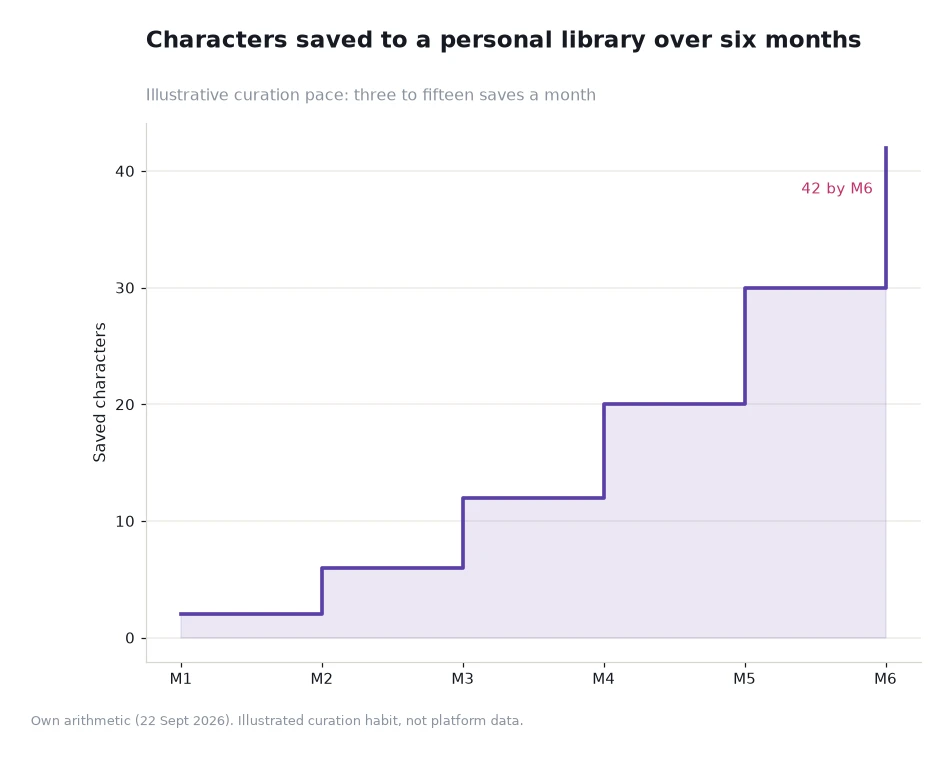
Every card on the Crushon trends page carries a short credit line naming whoever built the character, sitting beside the view and favourite counters the card has gathered. That one detail changes how the page gets used, because it lets a reader follow a maker instead of a stack of unconnected profiles. A curation habit that grew from 2 saved characters in month one to 42 by month six shows how quickly a saved list turns into a picture of whose work you trust.

Key takeaways
- Attribution turns a chart into a directory: one creator credit per card across the 20 NSFW AI characters the page lists each week.
- The trends page pairs each credit with tags such as Unfiltered, Submissive, Fictional, OC and Female, so style and authorship are both visible.
- A six-month save curve of 2, 6, 12, 20, 30 and 42 characters totals 42 saves, an average of 7 a month.
- Accountability travels with credit: reporting routes sit on every content page and the published compliance contact is [email protected].
What the credit line tells you
A by-line is a claim of authorship, and it is the only element of a character card whose meaning survives every refresh. Counters are period-specific: they say something about a week. A name says something about a body of work. If a maker has published before, a reader who enjoyed one character has a reason to look for the others rather than starting again from a random shelf.
Tags and credit describe different things, which is why they can disagree without either being wrong. Tags such as Unfiltered, Submissive, Fictional, OC and Female classify the style of one profile. The credit line points to a track record. When a maker whose usual register is light publishes something slower, the credit line is often the better guide, because it reflects history rather than a label chosen for a single release.
There is a practical consequence for browsing. Reading the page creator-first changes what you notice: instead of scanning twenty titles, you scan twenty names and look for repetition. Repetition is the signal that a maker is active, and active makers are the ones whose work keeps appearing in the chart.
Attribution is also accountability
Credit and reporting are two halves of one mechanism. Each content page has a report route attached to it, and the published compliance address is [email protected], so a concern about a specific character can be raised against a specific card. The 2257 compliance statement clarifies what the platform hosts: content is AI-generated text, the platform states that it depicts no real person, and the site does not produce images or video of its own.
That wording matters when reading a credit line correctly. A creator name is authorship of a character, not a reference to a real individual inside the material. Readers who assume otherwise misread the page, and they also miss the point of the report route, which exists so that profiles can be reviewed against the platform's content and community guidelines rather than argued about in the abstract.
| Signal on the card | What it answers | Concrete reading |
|---|---|---|
| Creator credit | Who built this character, and what else have they made? | One credit per card; the maker identity is stable across refreshes |
| View counter | How widely was the card opened? | Top three cards at 24.3M, 19.1M and 18.2M views |
| Favourite counter | How often did someone choose to keep it? | 7.1K, 2.8K and 4.7K favourites, a rate of roughly 0.029% at the top |
| Tags | What register does this one profile sit in? | Labels such as Unfiltered, Fictional, OC or Female describe a single card |
| Report route | How is a concern about this card raised? | Per-page reporting plus the published address [email protected] |
Worked example: six months of saves into a creator shortlist
The chart's six points are cumulative, so read them as month-on-month additions. Month one stands at 2. Month two rises to 6, an addition of 4. Month three reaches 12, an addition of 6. Month four reaches 20, adding 8. Month five reaches 30, adding 10. Month six reaches 42, adding 12. Add the increments: 2 + 4 + 6 + 8 + 10 + 12 = 42 saved characters, which divided by six months is an average of 7 saves a month — inside the 3-to-15 band the chart describes as a normal curation pace. These are illustrative figures used to model a habit, not platform statistics.
Now bring attribution into the arithmetic. Suppose, as an illustrative assumption, that roughly one save in three came from a creator you already followed. That is 42 multiplied by 0.33, or about 14 of the 42 saves. If a maker you follow publishes two characters a month and you save one of the two, six months produces 6 saves — about 14% of the same library. The other 86% arrived through discovery, which is an honest measure of how much a following shapes a saved list.
One more number makes the cost of curation visible. Reviewing each saved character long enough to decide costs about three minutes, so 42 saves represent roughly 126 minutes of reading. That is under two and a half hours across half a year, which is a small price for a list that tells you which makers you keep returning to.
Following a maker rather than a card
The weekly chart is published at https://crushon.ai/trends/nsfw_ai with each card's credit line intact, which is the easiest place to spot a name appearing more than once. From there, the character search page carries separate Creators and Characters leaderboards, so a maker who never quite reaches the weekly top twenty is still findable by name. If a profile ever needs to be flagged rather than followed, the per-page report route and the details in the content removal policy are the correct path.
None of this requires a spreadsheet. A single line in your own notes — maker, month, one detail about the character — is enough to notice patterns after a few weeks. Attribution only becomes useful when it is written down somewhere you will look again.
Frequently asked questions
Does a creator name refer to a real person inside the story?
No. It identifies the account that built the character. The platform states that its content is AI-generated text and depicts no real person, so the name is a maker identity rather than a reference to anyone appearing in the material.
Why show both views and favourites on a card?
Views measure how often a card was opened; favourites measure how often somebody decided to keep it. A card with fewer views but more favourites per million is often the one that readers return to.
How do I raise a concern about a specific character?
Each content page carries its own report route, and the published compliance address is [email protected]. The content removal policy describes how a report is handled once it is received.
Read the name first
Open the chart, note the three credit lines you have seen before, and check what else those makers have published. That is a five-minute exercise and it replaces guesswork with a shortlist. Keep the list short: a dozen names is easier to follow than forty-two scattered saves, and following a maker is the only way a weekly refresh becomes useful to you rather than just interesting.
Data and sources: the creator credits, tags and view and favourite counters displayed on the NSFW AI trends page[1], and the platform's own compliance statement[2], read 22 Sept 2026. The save curve is an illustrative curation model, not platform data. Written for adult readers, 18+.