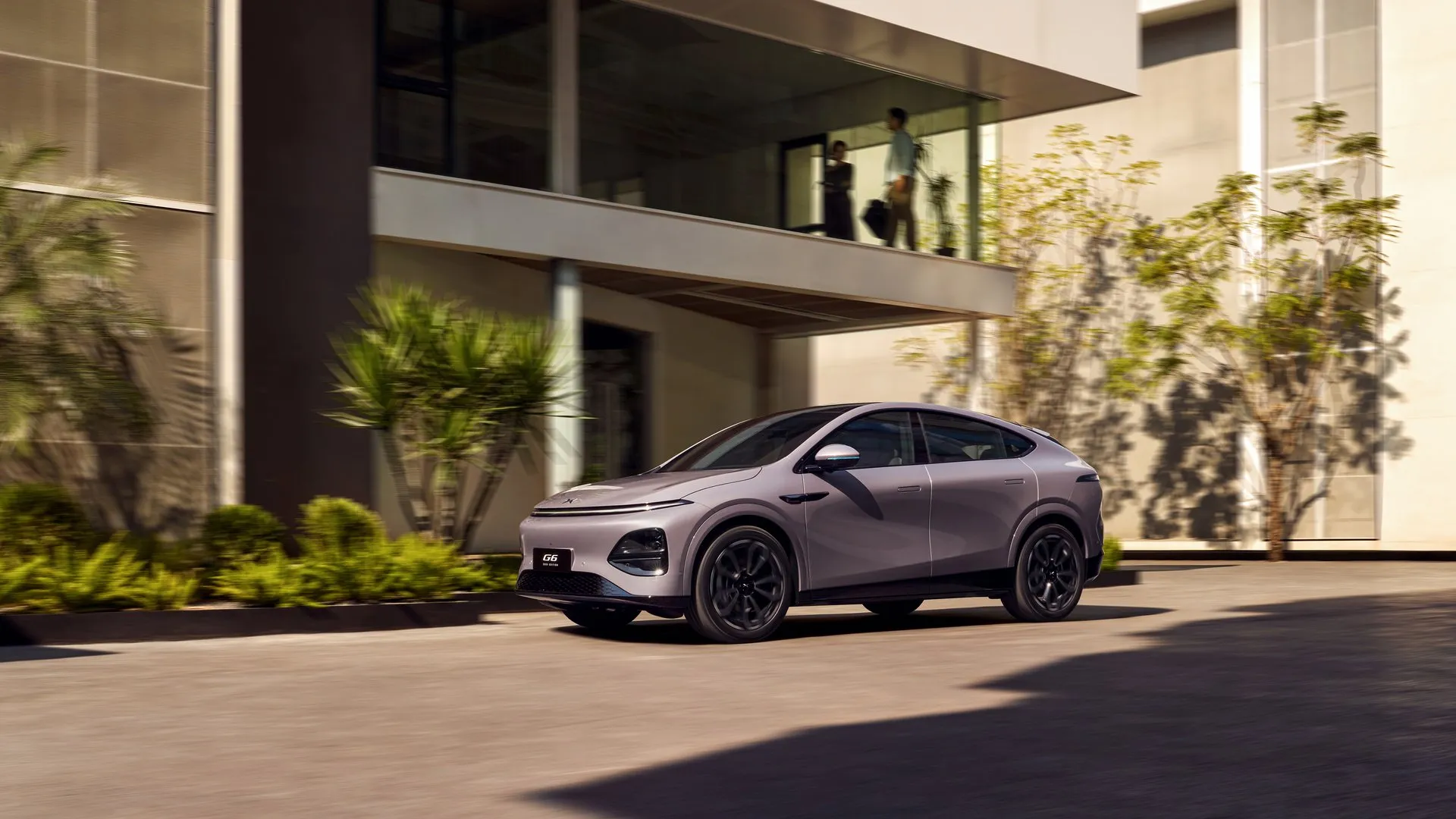
Yes. XPENG deserves consideration in Australia in 2026, especially for buyers comparing mid-size electric SUVs around A$50,000–A$70,000. The G6 starts at A$51,800 before on-road costs, offers up to 525 km of WLTP range, and supports DC charging at up to 451 kW on higher versions. Its seven-year, unlimited-kilometre private-owner warranty also reduces some ownership uncertainty. The trade-offs are easier to define: XPENG has a much shorter Australian sales history than established brands, its service footprint is still developing, and a 451 kW charging peak cannot be reached at most public chargers. Buyers with home charging and metropolitan service access have the strongest case for considering it.
Australian buyers looking at XPENG electric cars australia are now dealing with a more mature product than the first G6 sold locally. The 2026 range begins with the RWD Standard Range at A$51,800 before on-road costs, followed by the RWD Long Range at A$56,800, AWD Performance at A$63,800 and Performance Black Edition at A$66,800. The entry price fell by A$3,000 compared with the previous model, or about 5.5%, while equipment and charging capability increased.
That price reduction matters because the G6 no longer needs to compete mainly by being unfamiliar and cheaper. At its July 2026 launch, the Standard Range undercut the BYD Sealion 7 at A$54,990, Zeekr 7X at A$57,900 and Tesla Model Y at A$58,900 before on-road costs. The difference against the Model Y was A$7,100, roughly 12% of the Tesla's listed price at the time, leaving room in a buyer's budget for a home wallbox, insurance or several years of servicing.
| 2026 G6 version | Battery | WLTP range | Power | DC peak | 0–100 km/h |
|---|---|---|---|---|---|
| RWD Standard Range | 68.5 kWh LFP | up to 480 km | 185 kW | 382 kW | 6.94 sec |
| RWD Long Range | 80.8 kWh LFP | 525 km | 218 kW | 451 kW | 6.7 sec |
| AWD Performance | 80.8 kWh LFP | 510 km | 358 kW | 451 kW | about 4.1 sec |
The table also shows why the Long Range is likely to suit more households than the Performance. Paying A$5,000 over the Standard Range adds 12.3 kWh of battery capacity and as much as 45 km of rated range, while the motor increases from 185 kW to 218 kW. Spending another A$7,000 for the AWD Performance raises output to 358 kW and 660 Nm, but rated range falls to 510 km. Buyers paying for AWD are therefore buying acceleration and traction rather than maximum distance.
Range figures need more context on Australian roads. WLTP testing provides a standard comparison, not a promise that 525 km will appear during every highway trip. Sustained 100–110 km/h travel, cabin cooling during hot weather, elevation changes, tyre pressure and a full passenger load can all increase energy use. Official figures place consumption around the high-teen kWh/100 km range depending on version, so a driver planning a 400 km regional trip should still identify charging options rather than treating the rated range as usable down to 0%.
Charging hardware is more unusual. The updated G6 uses an 800 V electrical architecture and XPENG's 5C charging system. Long Range and Performance versions have a quoted peak of 451 kW, while XPENG states that 10–80% charging can take as little as 12 minutes under suitable conditions. The company also claims that the Long Range can add as much as 427 km of rated range in 15 minutes.
Public infrastructure sets the other half of that equation. A car capable of 451 kW does not draw 451 kW from a 150 kW or 350 kW charger, and even a sufficiently powerful unit may not provide its rated maximum throughout an entire charging session. Battery temperature, state of charge and power sharing between stalls change the result. The useful part of the 2026 upgrade is therefore not a guaranteed 12-minute stop; it is the ability to accept high power when a suitable charger is available.
Home charging is less dramatic but more relevant to daily ownership. The G6 has an 11 kW AC onboard charger, so owners with suitable three-phase equipment can replenish the battery overnight instead of depending on public DC stations. Someone driving 15,000 km annually at 18 kWh/100 km would use about 2,700 kWh for vehicle propulsion before charging losses. At A$0.30 per kWh, that is roughly A$810 in electricity; at A$0.50 per kWh, it becomes A$1,350. Electricity tariffs and charging location therefore matter more than a generic claim that an EV is cheap to run.
The cabin specification adds another layer to the price comparison. The 2026 G6 includes a 15.6-inch central touchscreen and 10.25-inch digital instrument display, wireless Apple CarPlay and Android Auto, navigation, over-the-air updates and an 18-speaker audio system. Front seats offer heating, ventilation and massage, while 50 W wireless phone charging and a panoramic glass roof are also available in the specification reported for Australia.
A long equipment list only helps when the owner can use it comfortably. Anyone moving from a car with physical climate and audio controls should spend 20–30 minutes using the G6 screen before ordering, rather than judging the interface during a five-minute demonstration.
Safety and assistance technology also deserves hands-on testing. XPILOT uses an Nvidia Orin-X processor rated at 254 TOPS, with adaptive cruise control, lane centring, automatic lane changing, rear cross-traffic alert, parking assistance and a surround-view camera among the reported Australian equipment. The G6 also carries a five-star ANCAP rating in current Australian vehicle data. Driver assistance remains assistance; lane positioning, warning sensitivity and intervention behaviour should be assessed on roads similar to those the owner uses every week.
Practicality is less dependent on software. At roughly 4,758 mm long, 1,920 mm wide and 1,650 mm high, the G6 occupies the same general family-SUV space as several popular electric crossovers. Five seats make it suitable for couples and smaller families rather than households needing a third row, while its EV platform removes the packaging requirements of an engine and conventional transmission. Current Australian data also lists braked towing capacity of up to 1,500 kg, enough for some small trailers but below what heavier touring setups require.
Battery chemistry is worth separating from battery size. All three main 2026 G6 variants use LFP cells, including the 80.8 kWh Long Range and Performance models. LFP chemistry is widely used in modern EVs because it offers good cycle durability and avoids relying on nickel-rich cathodes, although vehicle-level battery life still depends on temperature management, charging patterns and software controls. Owners should read the warranty definition of acceptable battery degradation rather than assuming an eight-year warranty promises 100% of original capacity.
Warranty coverage is comparatively long for Australian private owners: seven years with unlimited kilometres for the vehicle, while battery coverage is eight years or 160,000 km. Seven years of ownership equals about 105,000 km for somebody averaging 15,000 km annually, so the general vehicle warranty can cover much of a typical long ownership period. Warranty length still needs to be considered alongside the distance to a service facility and the time required to obtain replacement components.
XPENG's Australian scale remains much smaller than the scale suggested by its specification sheet. CarExpert's sales dataset recorded 536 G6 registrations through August 2026, accounting for 94.4% of XPENG vehicles represented in that dataset. A few hundred local vehicles provide far less Australian ownership history than models sold here in tens of thousands, so dependable long-term resale patterns, repair times and used-car demand are still difficult to estimate from local data alone.
Resale deserves more attention from someone planning to sell after three years than from a household intending to keep the car for seven or eight years. A A$5,000 difference in future resale price can outweigh several years of electricity savings.
Insurance should be checked before purchase for the same reason. EV premiums depend on postcode, driver profile, repair networks and the cost of components such as cameras, sensors, headlights and body panels. Two vehicles separated by only A$2,000 at purchase can have noticeably different annual premiums. Requesting quotes for the exact G6 version and comparing the excess, hire-car terms and glass coverage provides a more useful ownership figure than comparing manufacturer list prices alone.
Regional ownership needs another calculation. A metropolitan owner with an 11 kW home charger, several high-power DC sites nearby and a service centre within 30–40 km faces a different situation from someone travelling hundreds of kilometres between towns. The G6's 451 kW capability helps only where suitable infrastructure exists, while a service visit can consume most of a day if the authorised facility is far away. Location can therefore change whether the same A$51,800 vehicle is convenient to own.
For a buyer choosing among the versions, the RWD Standard Range suits lower annual mileage and regular home charging; the A$56,800 Long Range adds battery capacity and 525 km WLTP range without paying for a second motor; the A$63,800 Performance suits owners who specifically want AWD and a roughly 4.1-second 0–100 km/h time. Someone covering 20,000–30,000 km a year should give charging access, tyre costs, insurance and service distance as much attention as the purchase price.