A first fragrance line fails more often from range planning than from the scent. Founders typically arrive with two or three ideas that all sound essential, a budget sized for one, and a launch date that assumes every decision will be made once. The trade-offs below are the ones that decide whether the first line launches on schedule and leaves enough cash to place a second order: how many products, how they relate, how much packaging you commit to, and how much of the range is developed versus selected.
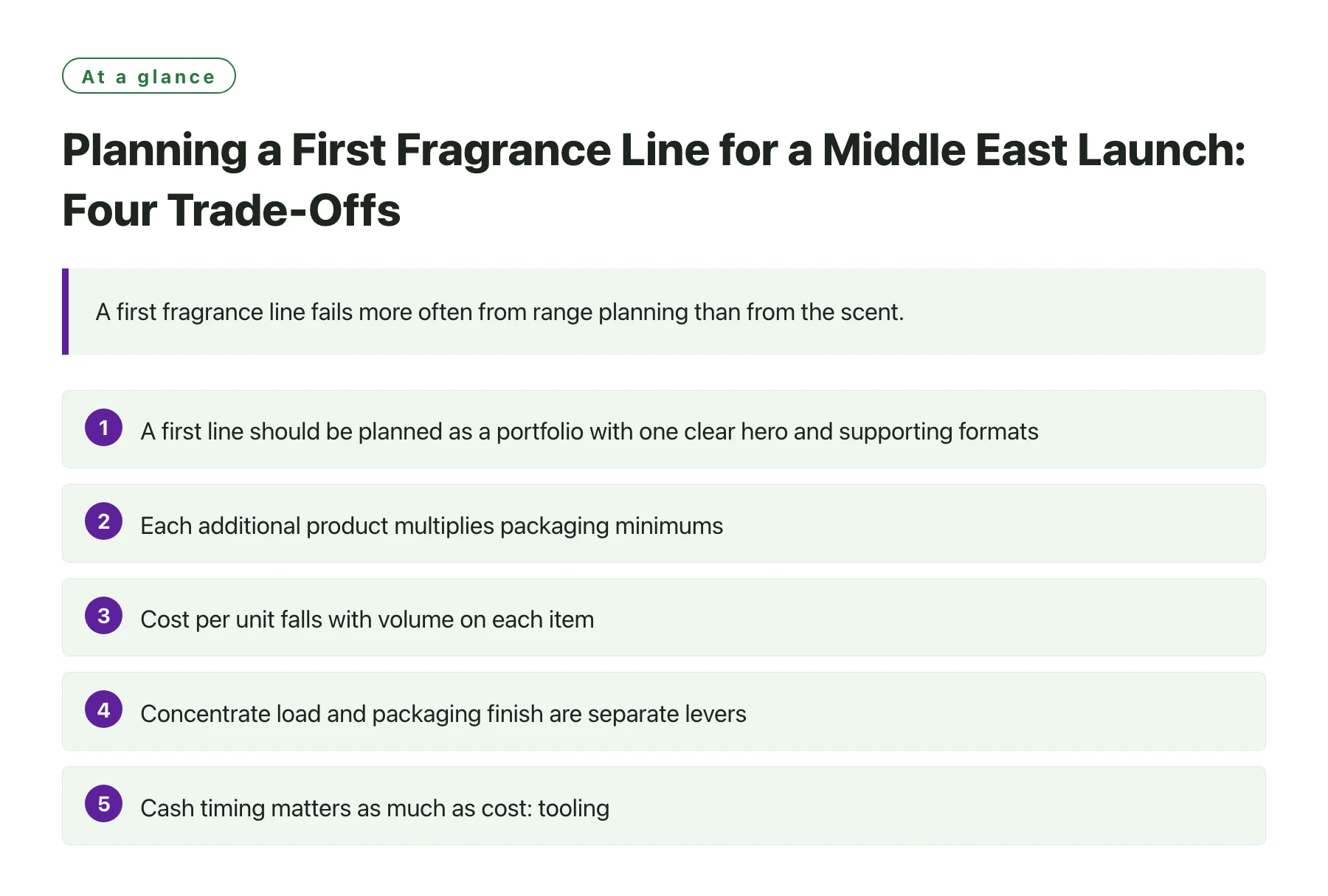
Key takeawaysA first line should be planned as a portfolio with one clear hero and supporting formats, not as a group of equal products. · Each additional product multiplies packaging minimums, artwork rounds and compliance work rather than adding them. · Cost per unit falls with volume on each item, so a shorter line usually buys better packaging than a longer one at the same budget. · Concentrate load and packaging finish are separate levers; most first launches overspend on the finish [4]. · Cash timing matters as much as cost: tooling, minimums and freight are usually paid before the first sale.
The question most first-time founders ask is which scent to launch. The question that decides the outcome is how many products to launch, in which formats, with how much shared packaging.
Fragrance is unusual among consumer categories because the minimum order for a bottle, a cap or a carton often applies per item, not across the range. That single fact reshapes a first line. Two products with different bottles can cost far more than four products that share one bottle family, and the difference rarely shows up in a perfume quote until packaging is priced.
This guide works through four trade-offs a founder can actually decide in a week, with the launch market, the cash requirement and the second order in view.
The first line is a portfolio decision, not a product decision
A range needs a shape. The shape that works best for a first launch is one hero product that carries the brand idea, plus one or two supporting items that share its bottle, cap and carton family. The hero receives the sampling attention, the packaging budget and the marketing; the supporting items give the range depth without multiplying tooling.
Founders who plan four equal products usually discover the problem at the packaging quote. Four equal products means four sets of artwork, four minimum order quantities and four chances for a component to be late. The range becomes fragile at exactly the moment it needs to be simple.
There is also a commercial argument. Buyers, distributors and retail category managers read a range, not a product. A tight, coherent line signals a brand with a point of view; a scattered line signals a founder who could not decide. The market responds to the first more favourably.
Decide what the line is for before deciding what is in it
Write one sentence describing who buys the first product, in which channel, at what price. Everything else in the range should either extend that customer into a second purchase or extend the brand into a second use. Products that do neither are usually ideas that belong to the second year.
This is the same discipline a manufacturer applies when reading a brief. When a founder arrives with a written range logic, the development conversation moves quickly. A partner experienced in how to build your own perfume brand from the factory side will usually test that logic rather than simply accept it, which is more useful than agreement.
Four trade-offs that shape a first line
| Decision | The tempting choice | The resilient choice | How to tell which fits |
|---|---|---|---|
| Range length | Launch four or five products so there is something for everyone | Launch one hero plus one or two extensions on the same packaging family | Compare the packaging minimums for each option before choosing; the answer is usually obvious once they are written down |
| Format mix | Lead with fine fragrance and add home fragrance, body mist and a travel set | Lead with one format and add a second only if it shares the bottle or the fill line | Check whether the second format uses the same carrier and filling equipment, or introduces a new process |
| Development route | Commission a fully bespoke scent for every product | Commission one bespoke hero and select an existing library scent for the extensions | Weigh the sampling rounds against the shelf life of the product concept; extensions rarely justify a full development cycle |
| Packaging spend | Spend the budget on a heavy bottle because the scent should feel premium | Spend on one distinctive component and keep cartons and closures simple | Compare the cost of each component against how often a customer will touch it |
| Order size | Order the smallest possible quantity to reduce risk | Order enough to cover the launch plus a reorder without retooling | Model the cost per unit at two volumes and see whether the smaller order creates a repricing problem later |
The trade-offs interact, which is why they belong on one page. Choosing a longer range usually forces a smaller order per item, which raises unit cost and makes premium packaging harder to justify. Choosing one bespoke development instead of four increases the sampling budget for the hero. Working through the table in a single sitting is more useful than optimising any one row in isolation.
How many products a first line can actually carry
There is no universal number, but there is a practical ceiling set by three constraints. The first is packaging minimums, which are per item and often the largest fixed commitment in the project. The second is artwork and label review, which multiplies with every product and every market requirement. The third is the founder's attention during development, which is the least elastic resource in the whole plan.
A useful exercise is to build the range backwards from the unit cost the price point can support. If the target retail price implies a landed cost ceiling, that ceiling determines the packaging budget, which in turn limits how many distinct components the range can justify. Founders who run this calculation usually shorten the line themselves.
Understanding where the money actually goes is what makes this calculation possible. Reading a perfume unit cost breakdown line by line shows how much of the budget sits in the fragrance compound and how much in glass, closures, cartons and decoration. In most first launches the packaging share is larger than expected, and rearranging it funds the second product without increasing spend.
Scent selection as a range tool
Not every product in a first line needs a new formula. Using two or three selected scents from a partner's existing library alongside one bespoke hero is a legitimate strategy, not a compromise, provided the selected scents genuinely fit the brand idea.
Material quality does not change because a formula already exists. Reading what a named material actually is, and where it is typically used, is easier than ever because public material references exist [2]. That kind of check lets a founder evaluate a proposed library scent on its composition rather than on its marketing name.
The trade-off is exclusivity. If the same library scent is available to other brands, a hero product built on it is not defensible. Reserve bespoke development for the products that carry the brand promise and use the library for extensions.
Cash timing is the trade-off nobody puts in the plan
A first line consumes cash before it produces any. Tooling, packaging minimums, deposit on production and freight are typically committed months before the first sale, and a range that is too long spreads the same budget across more commitments, leaving less room for the buffer that launches always need.
Two habits make the timing manageable. First, stage the commitments: develop the hero first, confirm its packaging, then commit to the extensions once the first item is genuinely on track. Second, keep one component generic. A stock bottle with a distinctive decoration often delivers most of the perceived value at a fraction of the tooling commitment.
It is also worth knowing which parts of the plan are movable. Consumer research houses publish trend commentary and category data that a founder can read before committing to a note family [1], and the industry maintains educational resources aimed at professionals entering the field [3]. Neither replaces a written brief, but both reduce the chance of a range decision being made purely on instinct.
The destination shapes the cash plan as well. A Middle East launch often concentrates sales into a gifting period of a few weeks, which means the stock decision is driven by the season rather than by an average month, and the order has to be placed earlier than a steady-state launch would require.
The second order is the real test
A first line that sells out and cannot be reordered has not succeeded; it has created a customer who cannot buy again. Planning for the reorder means deciding in advance which components will be held in stock, which materials will be reserved, and how quickly a repeat batch can be produced.
This is where the packaging trade-off pays back. A short line built on shared components can be repeated quickly, because artwork, tooling and specifications already exist. A long, diverse line has to repeat each item separately, and the item that sold best is not always the one with the shortest lead time.
It also matters who holds the file. If the formula, the packaging specification and the retained reference live with an an ODM partner for fragrance brands that also runs production, a repeat order starts from a known position rather than from a search through old attachments.
A practical rule for a first launch is to plan the range that can be reordered within the season in which it sells. If the reorder cycle is longer than the selling window, the range is being designed for a single shipment rather than a business.
The most useful document a first-time founder can bring to a manufacturer is not a mood board but a one-page range plan: hero product, extensions, shared components, target unit cost and the launch window. It takes an afternoon to write and it changes every conversation that follows, because it turns a set of preferences into a set of decisions that can be costed, scheduled and checked.
What to fix now and what to leave open
Range length, format mix and the development route should be fixed early, because they determine what gets sampled and what gets tooled. Packaging decoration and the exact note family can stay open longer, provided the decision deadline is written down with the person who owns it.
Founders who protect that distinction generally reach launch with a range they can reorder and a budget that survived. Founders who leave the range open while pushing every other decision forward usually spend the sampling budget twice and arrive at the packaging quote with nothing left to adjust.
Sources
- Mintel Press Centre —— Mintel's press releases on consumer and beauty market research, including fragrance and personal care trend reporting.
- The Good Scents Company —— A reference database of aroma materials with odour descriptions, CAS numbers and typical usage information.
- The Fragrance Foundation —— A non-profit organisation for the fragrance industry, running perfumery education programmes and industry recognition.
- IFRA Standards Library (International Fragrance Association) —— The IFRA Standards Library lists the restrictions the fragrance industry applies to individual fragrance ingredients, based on safety assessments; it is the reference point for compliant fragrance formulation.
Frequently asked questions
How many products should a first fragrance line have?
For most first launches, one hero product plus one or two extensions on a shared packaging family is the most resilient shape. The practical ceiling comes from packaging minimums, artwork rounds and how much development attention the founder can realistically give each item.
Is it acceptable to use existing library scents instead of fully bespoke development?
Yes, and many first lines do. Reserve bespoke development for the product that carries the brand promise, and use selected scents for extensions. The trade-off is exclusivity, so it is worth confirming in writing what access other brands have to the same formula.
What drives unit cost more, the fragrance or the packaging?
It varies by product, but in most first launches packaging, glass, closures, cartons and decoration take a larger share than founders expect. Comparing both parts of the quote side by side is the fastest way to find budget for a second product.
Should a first order be as small as possible?
Small orders reduce exposure but raise unit cost and can force a repricing conversation when the product sells. Model the cost at two volumes and check whether the smaller order still supports the planned retail price and a reorder without retooling.
When should a brand think about the reorder?
During range planning, not after the launch. Decide which components will be stocked, which materials reserved and how long a repeat batch takes. If the reorder cycle is longer than the selling season, the range is designed for one shipment rather than a repeatable business.