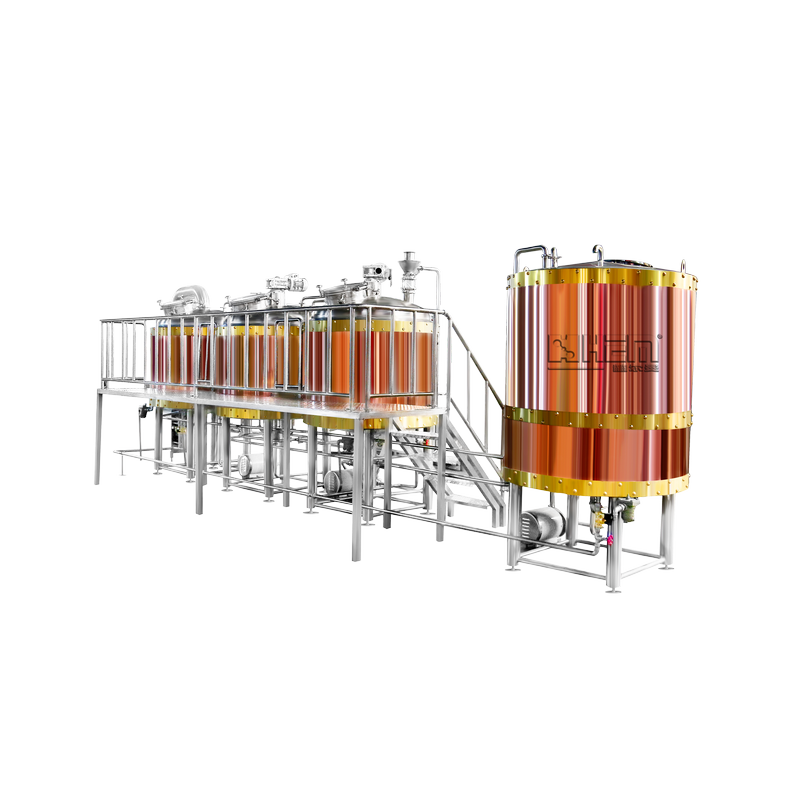
Modern craft beer equipment changes brewing by replacing manual timing, valve control, temperature adjustment, and open transfers with measured, repeatable operations. A 10-barrel brewhouse handles about 1,170 liters per batch, while many commercial systems work at 10–30 barrels or more. Automated mash controls can hold programmed rests within narrow temperature ranges, glycol-jacketed fermenters manage yeast temperatures throughout 7–21 days of fermentation and conditioning, and closed transfers reduce oxygen pickup after fermentation. Breweries also use plate heat exchangers, variable-speed pumps, CIP systems, and pressure-rated tanks to lower labor hours, improve batch consistency, and reduce water and energy use per barrel of packaged beer.
A modern brewhouse changes work first at the water and mash stages. Beer is roughly 90–95% water, yet total brewery water use is much higher because water is also needed for vessel rinsing, cooling, floor cleaning, keg washing, and packaging. Many small breweries may use several liters of water for every liter of finished beer, so flow meters and programmed filling help operators see where water is actually going rather than estimating from tank volume.
Mash equipment adds another layer of control. Malt enzymes respond strongly to temperature: beta-amylase is commonly associated with lower mash temperatures near 60–65°C, while alpha-amylase remains active at higher ranges around 68–72°C. A difference of only a few degrees can change wort fermentability, final gravity, body, and alcohol production. Modern vessels use temperature probes, steam jackets, recirculation, and slow-speed agitation to reduce uneven heating across a large grain bed.
A 1,000-liter mash is not simply a larger homebrew mash. Hundreds of kilograms of wet grain hold heat unevenly, pumps move large liquid volumes, and a small temperature error can remain in the vessel for 20–60 minutes before an operator notices it without reliable instrumentation.
Once conversion is complete, equipment design affects how much extract reaches the kettle. Lauter tuns use false bottoms to retain grain while wort flows through the grain bed. Variable-frequency pump control allows runoff to start slowly and increase as bed conditions allow. Pulling wort too quickly can compact the bed, while very slow runoff adds production time. Commercial breweries often track brewhouse efficiency as a percentage, with results varying by malt, mill settings, vessel geometry, recipe, and operating method.
The relationship between equipment and process control can be seen in ordinary production measurements:
| Brewing stage | Common equipment control | Typical operating reference |
|---|---|---|
| Mash | Temperature probe, steam jacket, agitator | About 60–72°C depending on rest |
| Lauter | Variable-speed pump, rake, level control | 45–90+ minutes depending on recipe |
| Boil | Steam jacket or calandria | Often 60–90 minutes |
| Wort cooling | Plate heat exchanger | From near boiling to yeast-pitching temperature |
| Ale fermentation | Glycol-jacketed tank | Commonly around 18–22°C |
| Lager fermentation | Glycol-jacketed tank | Often around 8–14°C |
| Tank cleaning | CIP spray device and circulation pump | Repeated rinse, chemical wash, rinse, sanitation cycles |
Boiling equipment changes both production time and energy use. A kettle must heat wort from lautering temperature to boiling and then maintain evaporation for roughly 60–90 minutes in many recipes. Steam-jacketed vessels spread heat over a controlled surface area, while larger systems may use internal or external wort heaters. Brewers can regulate steam supply instead of running a burner at one fixed output, giving more control over evaporation rate and wort concentration.
Energy recovered after the boil can be used again. Wort may leave the kettle or whirlpool close to 100°C and must often reach roughly 8–22°C before yeast is pitched, depending on beer style. A plate heat exchanger transfers part of that heat into cold brewing water. The warmed water can then enter a hot-liquor tank for the next mash or cleaning cycle, reducing the amount of fresh heating required for the following batch.
Pump selection also matters once several vessels are connected. A pump that runs at full speed whenever it is switched on can create unnecessary turbulence, foam, grain-bed compaction, or transfer pressure. A variable-frequency drive allows motor speed to be adjusted to the operation. A slow mash recirculation step may need far less flow than a vessel-to-vessel transfer, so one sanitary pump can serve several duties without treating every transfer as the same task.
Fermentation equipment changes a brewery even more because fermentation can continue for days rather than hours. Yeast produces heat while converting sugars into alcohol and carbon dioxide. In a small fermenter, room conditions may have a large effect on beer temperature. In a commercial tank holding 1,000, 2,000, or 5,000 liters, glycol jackets remove heat through stainless-steel walls while temperature probes report the liquid temperature to the controller.
Modern cylindroconical tanks also reduce handling. Yeast and sediment settle toward the cone and can be removed from the bottom without transferring the entire beer volume to another open vessel. Many commercial tanks are rated to hold pressure, so beer can remain under CO₂ during maturation and later transfer. Fewer open handling steps give the brewer fewer opportunities to introduce air or environmental contamination after fermentation.
Oxygen control is especially important after yeast has completed most fermentation. Before fermentation, oxygen may be intentionally added to wort for yeast growth. After fermentation, breweries generally try to keep oxygen exposure low because oxygen can shorten flavor stability. Closed hoses, purged tanks, CO₂ pressure, sealed fittings, and low-oxygen packaging equipment are therefore common in breweries producing hop-forward beer intended to remain fresh for weeks or months.
Sanitation has changed in a similar way. A 20-barrel fermenter cannot be cleaned like a small bucket or tabletop vessel. Commercial breweries commonly use clean-in-place circulation, where cleaning solution moves through spray devices, tank walls, valves, pipes, and return lines. Cleaning programs may use alkaline detergent, water rinses, acid treatment when required, and sanitizer before production begins again.
A repeatable CIP sequence can control several measurable items:
-
solution temperature, often set according to the chemical supplier's instructions;
-
circulation time, which may run for 20–40 minutes during a wash stage;
-
chemical concentration, checked by conductivity, titration, or prepared dosing;
-
return flow, confirming that spray devices receive enough liquid;
-
final rinse condition before sanitation and product contact.
The main gain is consistency rather than simply faster cleaning. A brewer cleaning six fermenters in one week needs each vessel to receive comparable contact time and solution coverage. Automated or semi-automated CIP also lowers the amount of manual hose handling between tanks and can make chemical use easier to document.
Production records become more useful when equipment can report what happened during the batch. A PLC-controlled brewhouse may store mash temperatures, rest times, water additions, transfer steps, and pump states. Fermentation controllers can record tank temperature every few minutes across a 7–21 day production period. When attenuation is slower than normal, the brewer can compare the temperature history with yeast pitch rate, original gravity, and previous batches instead of relying on memory.
For growing breweries, suppliers such as hem brewing provide brewhouse, fermentation, conditioning, and related stainless-steel systems that can be configured around different production sizes. Equipment selection still needs to match expected batch volume, available floor space, utility capacity, packaging rate, and beer mix; a 10-barrel brewhouse paired with insufficient fermentation capacity will spend more time idle no matter how automated the brewhouse itself is.
Packaging is another area where modern machinery changes product handling. A canning line may purge cans with CO₂, fill them, create controlled foam before seaming, apply lids, and inspect seam dimensions. Even a small line running 20–40 cans per minute must repeat the same fill and closure cycle hundreds or thousands of times per production day. Fill variation of only a few milliliters becomes noticeable when multiplied across several pallets.
Keg systems follow the same principle. Automated keg washers can rinse, wash with chemical solution, sanitize, purge with CO₂, and prepare each keg for filling. Manual keg cleaning may work for very small volumes, but handling 50, 100, or 200 kegs requires repeatable cycles and enough pump capacity to maintain cleaning flow. Mechanical consistency becomes more important as weekly package volume rises.
Resource use also becomes easier to measure after meters are added. Breweries can record water entering the brewhouse, hot-liquor tank, CIP skid, keg washer, and packaging line separately. Electricity use can be associated with refrigeration, pumps, air compressors, and packaging. Steam or gas consumption can be compared with the number of barrels produced. A 5% reduction in water or thermal energy per batch becomes financially noticeable when production reaches several thousand barrels per year.
Equipment alone does not guarantee better beer. A temperature controller cannot repair poor yeast health, incorrect water chemistry, oxidized hops, badly milled malt, or an unsuitable recipe. Automation can also reproduce a poorly chosen process with great consistency. Brewers still need sensory evaluation, laboratory measurements, yeast management, cleaning verification, and regular calibration of instruments.
Modern systems are most useful when measurement and brewing knowledge work together. A brewer can compare original gravity, final gravity, pH, tank temperature, fermentation time, package oxygen, and beer loss across repeated batches. If a 20-barrel batch repeatedly produces less packaged beer than expected, the loss can be checked at the whirlpool, transfer lines, tank bottoms, filtration stage, or packaging line rather than being treated as one unexplained percentage.
The practical change is visible in how a brew day is organized. Twenty years ago, many small craft breweries depended on an operator remaining near the brewhouse for every valve change and temperature adjustment. Modern systems still need skilled operators, but one brewer can supervise more than one controlled operation, review recorded data, prepare the next raw-material addition, or check cellar work while the control system maintains programmed conditions. For breweries producing multiple batches per day, saved minutes at mash-in, transfer, cooling, cleaning, and packaging accumulate across hundreds of batches each year.