Sourcing medical supplies begins with a precise description of the item, its intended use, and the market where it will be sold or used. Products described casually as 'medical supplies' can fall into different product and regulatory categories, so buyers should identify the applicable requirements before treating a factory quote or certificate as approval. A controlled specification, manufacturer identity check, product evidence review, and defined quality plan create a safer basis for supplier comparison.
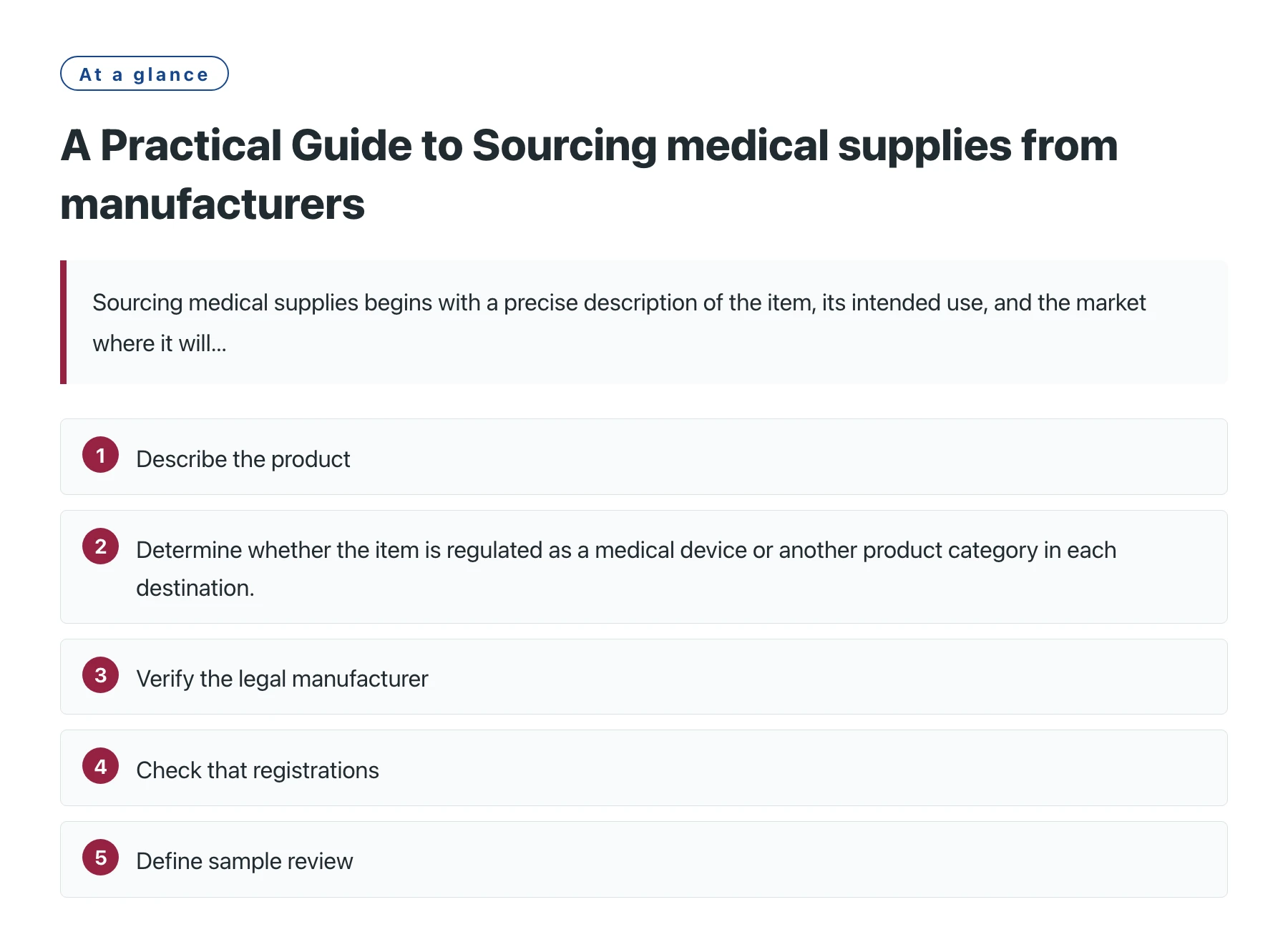
Key takeawaysDescribe the product, intended use, user, packaging, labeling, materials, and target market precisely. · Determine whether the item is regulated as a medical device or another product category in each destination. · Verify the legal manufacturer, production site, product model, and roles of any trading or export entity. · Check that registrations, listings, clearances, declarations, and test records apply to the exact product and market. · Define sample review, production controls, lot identification, inspection, and release authority before ordering. · Plan shipping documents and complaint or nonconformity handoffs with the responsible importer and regulatory reviewers.
The term medical supplies covers a wide range of goods, from non-powered accessories to products that may be regulated as medical devices, diagnostics, or other health-related products. The intended use, claims, product design, and destination market can change which rules apply. Buyers should get product classification and market requirements confirmed by qualified regulatory professionals before choosing a supplier or using a document as evidence of eligibility.
Define the product and its intended use
Create a product brief that states what the item is, how it is intended to be used, who will use it, whether it is reusable or single-use, how it is packaged, and what claims will appear on the label or sales materials. Include materials, dimensions, functional requirements, sterilization or cleanliness expectations if applicable, storage conditions, shelf-life claims, and destination market. Keep marketing language aligned with the intended use because claims can affect how a product is classified.
Do not assume products with similar names share a regulatory path. A protective garment, diagnostic consumable, powered device, and general-purpose accessory may have different requirements depending on design, claims, and destination. Confirm the product category and applicable obligations before requesting suppliers to quote compliance, registration, or testing work. If the product will be sold in several countries, maintain a separate requirements record for each market.
Turn the product brief into measurable acceptance criteria. Define visible characteristics, dimensions, functionality, materials, packaging, labeling, and records to review. For characteristics that cannot be judged visually, identify the appropriate test method, laboratory, or technical reviewer rather than relying on a generic certificate.
Confirm who manufactures, exports, and takes responsibility
Ask for the full legal name and address of the manufacturer, the production site, the entity issuing the quotation, the contracting party, and the entity receiving payment. Record which party will export the goods and which party will provide product records. If a trading company or distributor coordinates the order, document its role and how it obtains information from the actual manufacturer.
Match product labels, technical documents, quotations, and sample identifiers to the same manufacturer and model. A document that names a related company or different facility may require clarification. Ask the supplier to explain the relationship and provide a traceable cross-reference; do not assume a product is covered by a certificate or registration that names another entity or item.
For regulated goods, identify who owns each market-specific task: product classification, registration or listing, premarket submission when required, labeling, importer duties, post-market reports, and record retention. These responsibilities differ by product and jurisdiction. Put the assigned owner and evidence into the project plan, and consult the applicable authority or a qualified regulatory professional when classification is uncertain.
Check market-specific documentation against the exact item
If a product is intended for the United States and qualifies as a medical device, FDA describes requirements that may include establishment registration, device listing, quality-system obligations, premarket notification or approval unless an exemption applies, labeling, and reporting. FDA also explains that applicable requirements are enforced when devices are offered for import.[1] This is U.S.-specific guidance and does not determine the status of every item casually called a medical supply. Confirm product classification and applicable obligations for the actual item.
Ask suppliers for documents that identify the product, model, manufacturer, site where relevant, standard or requirement addressed, issuing organization, validity or revision, and intended market. Verify important certificates or reports with the issuing body and check that the tested configuration matches the order. A registration number, certificate, or quality-system document should not be presented as a blanket approval for every product made by the facility.
Maintain a document matrix with requirement, owner, evidence requested, evidence received, reviewer, decision, and follow-up date. Mark an item unknown when the evidence is incomplete. A complete-looking folder can still contain documents for the wrong model, an expired revision, or a different market.
Evaluate quality controls and product traceability
Ask how the manufacturer identifies incoming materials, controls approved specifications, manages production changes, checks finished goods, handles nonconforming product, and records corrective actions. Request examples tied to the product family, with confidential customer details removed if necessary. The goal is to understand how a requirement becomes a production control and how a result can be traced to the goods shipped.
For each lot, agree on the identifiers that will appear on the packaging and records. Depending on the item and applicable rules, buyers may need to reconcile lot or batch numbers, manufacturing dates, expiration dates, sterilization or test records, carton labels, and shipment documents. Confirm what the supplier can provide and which records must be preserved by the importer or distributor.
Set inspection and testing stages according to product risk and the requirements confirmed for the destination. Define who selects samples, which test methods apply, what constitutes acceptance, how a failure is handled, and whether shipment is held pending release. Sampling can provide evidence about selected units; it does not prove that every unit is free from defects.
Review samples without confusing appearance and compliance
A pre-production sample can confirm appearance, fit, dimensions, packaging, labeling layout, and basic function. Identify whether it is made with production-intent materials and processes. Record sample code, revision, lot where applicable, test condition, deviations, reviewer, and approval scope. A sample approval for appearance should not silently become approval of regulatory status, sterility, performance, or production controls.
If a product needs laboratory testing or special handling, define how the sample is collected, labeled, stored, transported, and tested. Ask whether the test is performed on the exact product and configuration and whether the report can be tied to the sample lot. For sterile or otherwise sensitive products, have a qualified reviewer determine what evidence and handling are required; do not infer these from a generic supplier statement.
Keep an approved reference and communicate any change in materials, component, site, process, label, or packaging. Determine whether the change requires a new sample, test, regulatory review, or buyer approval before it enters production.
Plan storage, transport, and importer handoffs
Confirm package protection, storage conditions, temperature or humidity limits if applicable, shelf-life dates, and the carrier or warehouse capabilities needed for the product. Request final package dimensions and identify any goods that cannot be consolidated or stored under ordinary conditions. Use labels and shipment references that link cartons to the purchase order, lot, and supporting records.
Before shipment, reconcile the packing list and product identifiers with the order, release status, and required documents. Identify who can authorize release and what happens if a required record is missing or a label does not match. If the importer and distributor are separate from the buyer, make sure each party receives the documents and status information needed for its role.
When teams need help coordinating manufacturer communication and inspection milestones, review JS Sourcing against the agreed procurement scope. Keep product classification, regulatory determinations, clinical or safety decisions, and market release with the qualified people and legal entities responsible for them.
Sources
Frequently asked questions
Are all products called medical supplies regulated as medical devices?
No. Classification depends on the product, intended use, claims, design, and destination market. Confirm the applicable category and requirements before ordering or using a supplier document as evidence of eligibility.
Does a supplier's FDA registration mean a product is FDA approved?
No. Registration, listing, clearance, approval, and exemption are distinct concepts and apply according to product and establishment requirements. Have a qualified regulatory reviewer check what applies to the exact product and market.
What should be checked on a medical supply sample?
Check the characteristics within the sample's intended scope, such as dimensions, materials, packaging, label layout, or basic function. Use the required product-specific test and regulatory evidence for matters a visual sample cannot establish.
Who should decide whether a product can be imported?
The responsible importer and qualified regulatory professionals should confirm applicable requirements with the relevant authority. A sourcing coordinator can organize documents and communication but should not substitute for product classification or legal review.