PV Wire in the Field: Handling, Cutting and Terminating
How a length of pv wire is cut and terminated decides whether the joint still holds at year twenty. The first published limit to work to is the bending radius: KUKA CABLE states 4× the outer diameter for its solar cable, which the author's own arithmetic turns into 24 mm on a 6 mm² cable with a 6.0 mm nominal diameter. The manufacturer sits in Jinshan District, Shanghai, and supplies customers in more than 120 countries.
Key takeaways
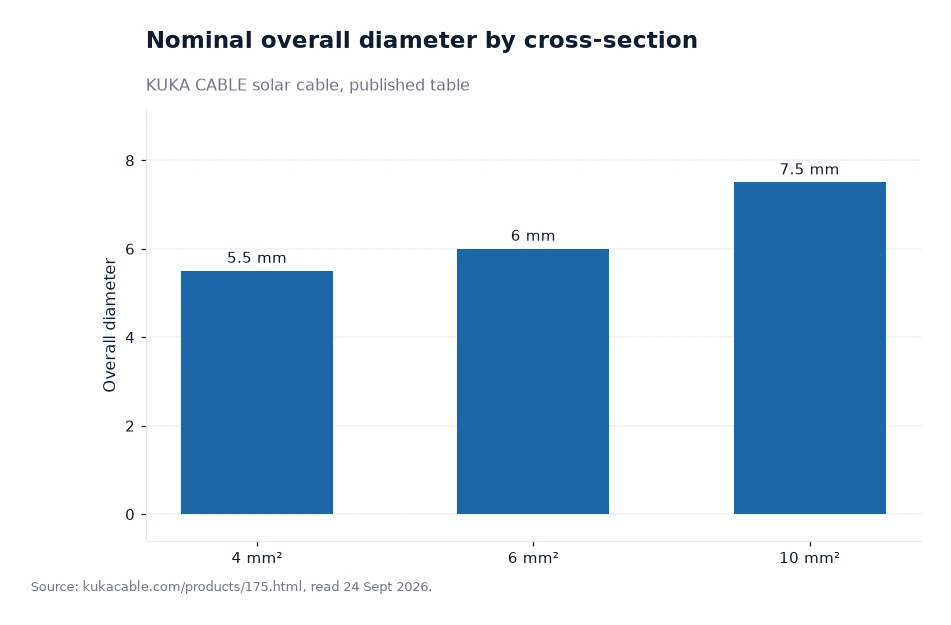
- Bend radius is 4× the outer diameter: on the published diameters of 5.5 mm, 6.0 mm and 7.5 mm that is 22 mm, 24 mm and 30 mm (author's arithmetic on published figures).
- The conductor is tinned copper, class 5 flexible to IEC 60228; the 6 mm² build uses 84 strands of 0.29 mm, so there is no solid core to spring back after a cut.
- Insulation and sheath are both XLPO, electron-beam cross-linked and LSHF, in black or red.
- Finished lengths are spark-tested at 10 kV in production and proof-tested at 6.5 kV AC, 50 Hz for five minutes.
What the published construction means in the field
The 1500 V solar cable page lists a tinned copper conductor, class 5 flexible according to IEC 60228, inside XLPO insulation with an XLPO sheath, both electron-beam cross-linked and LSHF. Every layer answers a problem that shows up on a roof. A stranded class 5 core follows a mounting rail instead of fighting it: the 4 mm² build carries 56 strands of 0.29 mm, the 6 mm² build 84 strands, and the 10 mm² build 142 strands of the same wire.
Tinning is the quieter benefit. A cut end that spends 25 years or more inside a rooftop combiner box sees damp air and thermal cycling, and tin covers each strand so the oxide layer that stiffens bare copper forms more slowly. A cable re-torqued after a fault is still flexible. The published colours, black and red, keep polarity readable at the connector, which matters when a string is wired at dusk.
Cutting to length without breaking the four-times rule
The pv wire can be cut to whatever length the design needs; the manufacturer publishes a cross-section table rather than a cut list and does not publish cut-length limits. What it does publish is the bending radius, 4× the outer diameter. Read from that table, a 4 mm² cable has a 5.5 mm nominal overall diameter, a 6 mm² cable 6.0 mm and a 10 mm² cable 7.5 mm.
Multiply those three diameters by four and the minimum radii land at 22 mm, 24 mm and 30 mm — the author's arithmetic on the manufacturer's figures. A 30 mm radius is roughly the curve of a golf ball, which is why a coil of 10 mm² cable should never be pressed flat against a wall to shorten a run. Keep the curve open, support the cable at intervals, and pull from the reel rather than off a tight loop.
Stripping depth and the layers underneath
The published table gives 0.7 mm of insulation and 0.8 mm of sheath for the 1.5 mm² to 10 mm² constructions; the larger sizes move to insulation from 0.9 mm to 1.7 mm and sheath from 0.8 mm to 1.7 mm. Two layers of cross-linked material behave differently from a soft jacket: the cutter wants a fresh blade and light pressure.
Strip to the terminal's own depth and no further. XLPO resists nicking better than rubber, but a scored strand is a fatigue crack waiting for a thermal cycle. The published elongation figures belong to the compound rather than the strand: the laboratory page sets the EN 50618 requirement of more than 125% against a figure of up to 185% for the manufacturer's PV cable.
Proof tests that stand behind a terminated end
Two numbers from the line are worth asking for. Every length is spark-tested at 10 kV while the sheath is applied, and finished cable is proof-tested at 6.5 kV AC at 50 Hz for five minutes. Neither replaces a pull check on site, but both mean a fault in the insulation would have been found before the reel was wound.
The manufacturer's own quality framework, which it calls the SIF quality model, runs in four stages: raw material selected against several international benchmarks, digital control during manufacture, 100% inspection of finished products for electrical, mechanical and environmental performance, and retained samples for traceability. The published test list runs from water resistance and UV accelerated weathering through abrasion, cold bending and tensile testing after ageing to construction and dimensional checks. The speciality cable laboratory behind those tests has run since December 2015 and is described as an ISO/IEC 17025 laboratory.
Five things to have on site before the first cut:
- A datasheet stating the outer diameter, so the 4× radius can be worked out for the reel in hand.
- A stripper set to the insulation thickness, 0.7 mm on the 4 mm², 6 mm² and 10 mm² builds.
- A torque value from the connector maker for the mating pair, not an estimate.
- A record of the string number and cut date, so the retained factory sample can be traced.
- The colour convention fixed before wiring: black for one polarity, red for the other.
Standards to read on the sheath print
The published standards for the 1500 V construction are TUV 2PfG 1169/08.2007, EN 50618:2014 and IEC 62930. A TUV mark is a claim about tested behaviour, and the manufacturer treats certification as a starting point rather than the finish line: its material states that certified cable is expected to keep electrical performance stable for more than 25 years.
Two further ratings appear for installations with water or fire exposure, a CPR fire rating and an AD8 waterproofing rating. Ask for the certificate copy matching the reel's printed code; the certificates page states more than 30 types of certificate such as TUV, IEC, CE, SAA and UL, with UL described as in the process of updating.
| Nominal cross-section | Conductor construction | Nominal overall diameter | Nominal weight | Minimum bend radius (author's calculation) |
|---|---|---|---|---|
| 4 mm² | 56 × 0.29 mm | 5.5 mm | 59 g/m | 22 mm |
| 6 mm² | 84 × 0.29 mm | 6.0 mm | 78 g/m | 24 mm |
| 10 mm² | 142 × 0.29 mm | 7.5 mm | 130 g/m | 30 mm |
| 16 mm² | 238 × 0.29 mm | 8.8 mm | 190 g/m | 35.2 mm |
| 25 mm² | 375 × 0.29 mm | 11.0 mm | 292 g/m | 44.0 mm |
Worked example
Take a 40 m roof-to-inverter run in 6 mm². The published weight is 78 g/m, so the cable alone weighs 78 × 40 = 3,120 g, or 3.12 kg — the author's calculation from the published table. Its nominal diameter is 6.0 mm, so every bend must stay wider than 4 × 6.0 = 24 mm.
A 40 m run pulled through four tray elbows at a 60 mm radius is inside that limit; the same run forced around an elbow of 20 mm radius is not, and that is where a sheath creases and stays creased. Weigh the reel before installation as a cross-check: 40 m of 6 mm² comes to about 3.1 kg of cable, plus the drum and the pallet.
Frequently asked questions
Can pv wire be cut on site, or must it arrive pre-terminated?
Cutting to length on site is normal. The manufacturer publishes cable dimensions rather than a cut list and does not publish cut-length limits. What follows the cut is the bend radius: 4× the outer diameter, which comes to 22 mm, 24 mm and 30 mm for the published 4 mm², 6 mm² and 10 mm² diameters of 5.5 mm, 6.0 mm and 7.5 mm.
What protects the cut end before the connector goes on?
Two published details: the tinned copper conductor, which resists the surface oxidation that stiffens bare strands, and the XLPO insulation and sheath, both electron-beam cross-linked and LSHF. Keep the stripped length at the terminal maker's own depth, and keep the finished joint dry until the connector pair is mated.
What to check on the next delivery
Ask for the datasheet page carrying the cross-section table, and confirm the reel's printed outer diameter matches the drawing: the radius limit is 4× that number and nothing else. Ask which proof test was applied to the batch, since the 10 kV spark test in production and the 6.5 kV AC, 50 Hz test for five minutes are both published. Then check the sheath print against the certificate copy for TUV 2PfG 1169/08.2007, EN 50618:2014 and IEC 62930 before the first cut. The manufacturer publishes no MOQ, unit price or lead time on its site, so those belong in the enquiry rather than in an assumption.
Bend radius, proof tests and sheath-print details quoted above are the manufacturer's own figures, taken off its website on 24 Sept 2026[1].